The PM’s Guide to Writing an AI Agent Brief
A practical template for product managers assigning work to AI agents without losing judgment, context, or review control.
2 minute read
Mukesh Swamy
Skills for PM
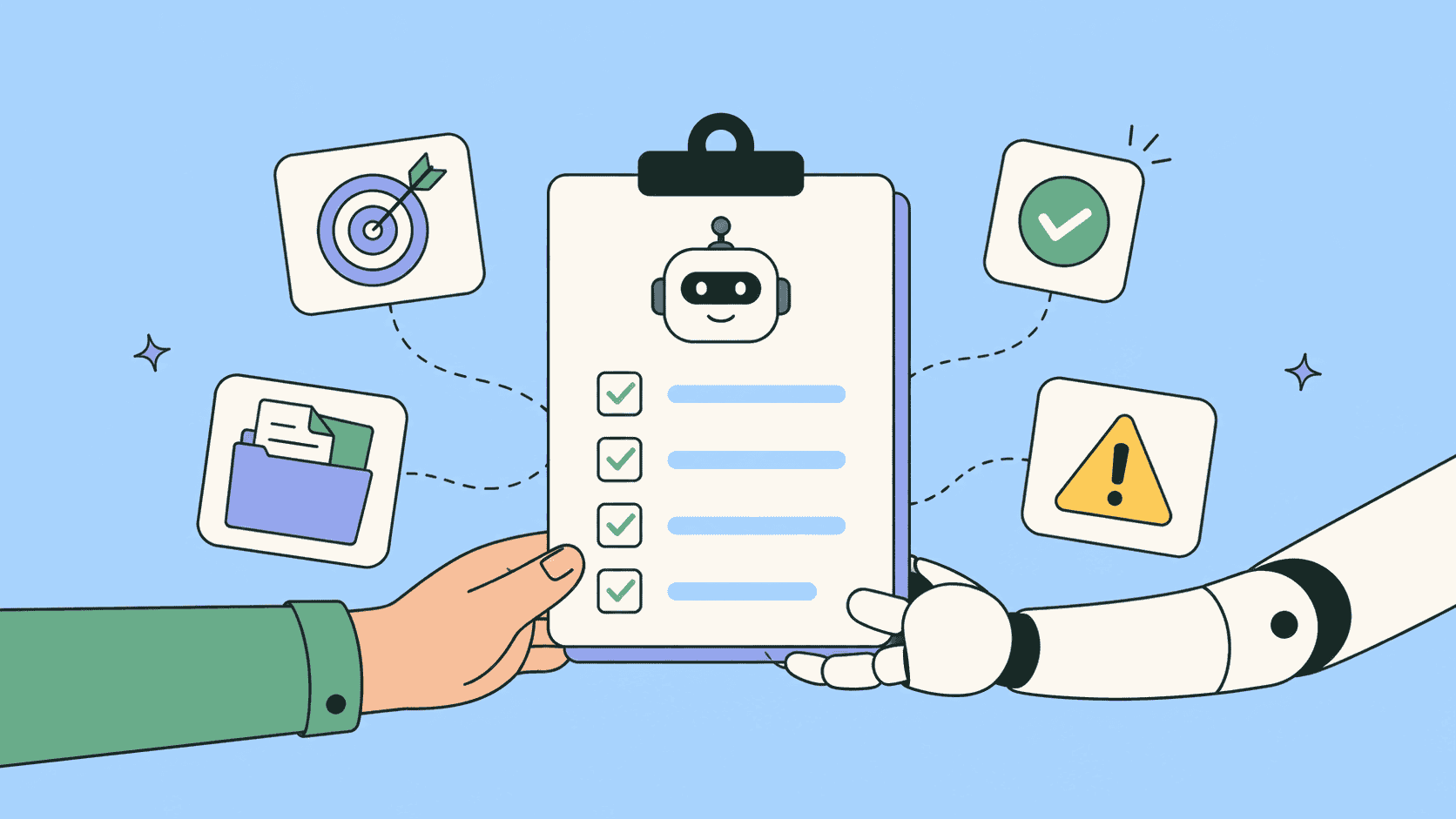
AI agents are most useful when product managers stop treating them like chat boxes and start treating them like junior collaborators with strict briefs.
An AI agent brief is a structured work order that defines the goal, the context, the allowed actions, the output format, and the review bar before the agent starts.
What goes into an AI agent brief?
Every useful brief has five parts: a one-sentence goal, task-specific context, explicit boundaries, an exact output format, and review criteria.
Use this structure:
1. Goal
State the outcome in one sentence.
Example: “Draft a segmented in-app announcement and changelog entry for the new team permissions workflow.”
2. Context
Provide only the context needed for the task:
- target users
- feature behavior
- customer problem
- related feedback
- release date
- pricing or permission constraints
- product terminology
- existing docs or examples
3. Boundaries
Tell the agent what not to do:
- do not invent unsupported claims
- do not mention unreleased features
- do not publish anything directly
- do not change pricing language
- ask for review when source material conflicts
4. Output format
Specify the exact output:
- title
- summary
- user-facing copy
- internal notes
- questions for reviewer
- metadata
5. Review criteria
Define how the PM will judge the result:
- accurate to product behavior
- clear for target segment
- no hallucinated promises
- specific next action
- consistent with brand voice
- easy to publish in downstream surfaces
A copy-pasteable brief
Goal: [specific product outcome]

Context:
- Product area:
- User segment:
- Current behavior:
- New behavior:
- Customer evidence:
- Rollout constraints:
- Related docs or assets:

Boundaries:
- Do not invent details not present in the context.
- Flag uncertainty instead of guessing.
- Do not publish or send externally.

Output:
1. Recommended title
2. 3-sentence summary
3. Draft customer-facing copy
4. Internal reviewer notes
5. Questions or missing context

Review criteria:
- Product accurate
- Segment-specific
- No unsupported claims
- Clear next action
- Ready for human approval
The practical takeaway
The PM’s job is not to let the agent “handle it.” The PM’s job is to design the work so the agent can produce useful drafts while human judgment stays in control.
Frequently asked questions
What is an AI agent brief?
An AI agent brief is a structured work order a product manager gives an AI agent before work starts. It defines the goal, the context, the boundaries, the output format, and the review criteria.
How is an agent brief different from a prompt?
A prompt is a one-off instruction. A brief is a reusable structure that carries product context, constraints, and a review bar, so output quality does not depend on clever wording.
Should AI agents publish work directly to customers?
No. A good brief keeps a human review step before anything reaches customers, and instructs the agent to flag uncertainty instead of guessing.
Free resource
Get the AI-first PM workflow map
A practical checklist for turning discovery, feedback, releases, docs, tours, and surveys into repeatable AI-assisted workflows.
No spam. Unsubscribe anytime.